
What Is Colour Therapy? How Chromotherapy Works and What to Expect
- ByRavinder Singh Sahota
- September 28, 2026
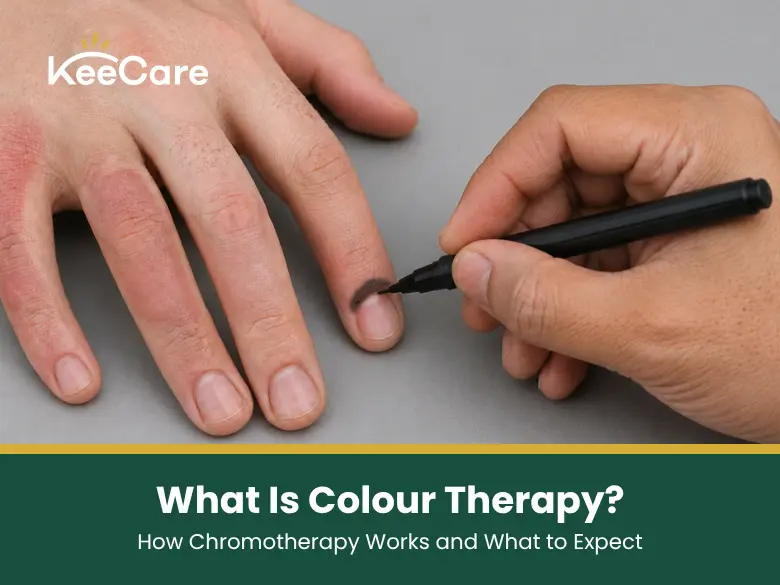
Colour therapy, sometimes referred to as chromotherapy, is a complementary wellbeing practice that uses colour within different traditional and therapeutic frameworks. Practitioners may associate colours with different emotional, energetic or wellbeing qualities. Different colours of visible light correspond to different energy. Within colour therapy traditions, colours are also assigned different symbolic or wellbeing associations, although these therapeutic associations are not established medical effects.
At KeeCare in Upper Norwood, London, colour therapy is delivered using a distinctive approach that sets it apart from light-based chromotherapy. Washable, non-toxic water-based sketch pens are used to apply specific colours directly to points on the body, a distinctive method used by KeeCare’s practitioner since 2020. Whether you are new to colour therapy or simply curious about what a session involves, this guide explains the principles behind it, what to expect and how the KeeCare approach works.
Key Takeaways
- Practice influenced by longstanding traditions. Colour has held symbolic and wellbeing-related significance across several historical traditions, including Chinese and Ayurvedic systems. Modern colour therapy builds on these foundations with structured frameworks for applying colour therapeutically.
- Colour as energy. Sunlight carries energy, which warms up the Earth and is the driving force behind all our weather and climate. Sunlight is a basic need of life. All living beings need it to survive. Light can be broken down into colours, which indicates that colour is also a basic need of life. The use of colour to promote healing and wellness is also called Chroma-therapy where researchers study how light enters body, whether through the eyes or skin, and determines what effects it has on our brain and our body as a whole.
Colour can also enter the body through skin. The energy from the colour is transferred to the specific organs where the energy is needed. Within colour therapy traditions, each colour is understood to carry a distinct vibrational quality that may influence the mind and body in different ways. - KeeCare’s approach is distinctive. At KeeCare, colour therapy involves applying colour directly to specific body points using washable, water-based sketch pens, a method introduced to the UK by KeeCare’s practitioner in 2020.
- Needle-free and non-invasive. Colour therapy at KeeCare does not involve needles. It may be of particular interest to clients who prefer to avoid needles but still wish to work with body energy points.
- Personalised to the individual. The colours and body points used in a session are selected based on the client’s individual concerns and the practitioner’s assessment, rather than following a fixed protocol.
- Explored for emotional and physical wellbeing. Some clients explore colour therapy as a complementary support for back pain or any joint pain, headache/migraine, lungs wellbeing, Heart & circulation wellbeing, liver wellbeing, men & women’s wellbeing, fertility & conception support, eyes & ears health, Kidney & urinary bladder health, skin wellbeing, stress/anxiety, emotional balance, Digestive discomfort & constipation, and general vitality.
- Complementary, not a replacement. Colour therapy is designed to complement conventional medical care, not replace it. Always continue with any treatment your doctor has recommended.
- No GP referral needed. You can book a colour therapy consultation at KeeCare without a referral from your GP.
What Is Colour Therapy?
Colour therapy is a complementary practice based on the understanding that colour, as a form of visible light, carries energy. Different colours correspond to different energy within the visible spectrum. Colour can enter the body through the skin. The energy from the colour is transferred to the specific organs where the energy is needed.
The use of colour in healing has ancient roots. References to the therapeutic use of colour appear in Egyptian, Greek, Chinese and Ayurvedic traditions. Modern colour therapy developed through a variety of approaches that used colour, coloured light and symbolic colour associations within complementary practice.
Today, colour therapy is used in a range of complementary therapy settings. Approaches vary: some practitioners use coloured lights or filtered lamps, while others apply colour directly to the body. The colours are applied at a specific energy point and they penetrate skin to alter the Energy Point underneath thus providing the appropriate healing to the ailment.
Once administered, the person can continue with his/her daily chores. The treatment is carried out using sketch pens that are easily available in the market.
Colours administered are to be retained on hand for a minimum of 6 to 8 hours a day until full relief from disease. And when there are no symptoms, the treatment continues for one more week and then the treatment can be stopped. If colours are washed off, one could reapply the colour. Each time the old colours need to be completely washed off and then the new colours are to be applied.
The best results are experienced when applied in the presence of sunlight, however it provides satisfactory results even when applied under electric light.
Colours emit light of a certain frequency/wavelength, and a particular light penetrates skin and directly affects the Energy points underneath.
Wondering whether colour therapy might be a good fit for what you are looking for? Contact our team to discuss your concerns and book a free initial consultation.
What Is Chromotherapy and How Does It Differ from Colour Therapy?
Chromotherapy and colour therapy are terms that are often used interchangeably, although some practitioners distinguish between them. Chromotherapy typically refers to the use of coloured light applied through filters or lamps. Colour therapy is sometimes used as a broader term covering light-based methods alongside other approaches, such as applying colour to the body or using colour in visualisation and environmental design.
In practice, the two terms overlap, and the method used will depend on the practitioner and the tradition they draw on. Both approaches use colour within complementary wellbeing frameworks, although their methods and underlying theories can differ.
The KeeCare approach falls within the broader definition of colour therapy. Rather than using coloured light, the practitioner applies colour directly to specific body points using water based washable, non-toxic sketch pens. You can read more about how sessions are structured on the colour therapy at KeeCare page.
How Does Colour Therapy Work?
The mechanisms proposed within colour therapy are theoretical frameworks used within complementary practice. They are not medically established mechanisms, and the evidence base varies depending on the application.
One framework draws on Eastern traditions and the concept of energy centers within the body, sometimes referred to as chakras. Within this model, different colours are understood to correspond to different energy areas, and applying a particular colour is thought to support balance in the corresponding part of the body or aspect of wellbeing.
Scientific research has examined how light exposure can affect biological processes such as circadian rhythms and mood. However, this research should not be taken as evidence that the specific colour therapy method used at KeeCare produces the same effects. This is an active area of scientific inquiry, though the specific claims of colour therapy remain areas of ongoing research rather than established clinical facts.
Research says colour can absolutely affect your mood, behaviours and stress levels. They influence the flow and amount of energy in our bodies. In healing, colours act as balancers: we administer the colour(s) someone needs more of, or we give the opposite of the colour someone has too much of.
However, true healing comes when the root cause of the condition/illness is addressed and transformed. If healing does not go further than mere relief or masking of the symptoms, then, eventually the disease/illness will resurface and manifest itself within the body in one form or another.
At KeeCare, the approach draws on colour therapy principles alongside knowledge of energy points on the body. Washable, non-toxic sketch pens are used to apply specific colours to body points, combining both frameworks in a session tailored to the individual.
Curious about how colour therapy might address what you are experiencing?
Our practitioner can walk you through the approach during a free 30-minute consultation at KeeCare.
What Are the Different Colours Used, and What Might They Represent?
Within colour therapy traditions, each colour is associated with qualities, areas of the body or emotional states. These associations vary between different colour therapy systems, and the following provides a general overview of how colours are typically understood in practice.
| Colour | Traditional Associations in Colour Therapy |
|---|---|
| White | Soul |
| Pink | Mind |
| Red | Direction |
| Orange | Time |
| Yellow | Earth |
| Green | Water |
| Sky Blue | Fire |
| Indigo | Wind |
| Violet | Space or Sky |
| Black | Nothingness |
These associations represent the frameworks used within colour therapy practice and should not be understood as medical claims about the effects of individual colours. The specific colours used in any session at KeeCare will depend on the practitioner’s assessment of the client’s individual concerns.
What Does Colour Therapy Help With?
Colour therapy is explored by some clients as a complementary approach to a range of physical and emotional concerns. The evidence base varies by application, and colour therapy should always be considered alongside rather than instead of conventional care.
KeeCare Colour Therapy vs. Traditional Chromotherapy: What Is the Difference?
Many people exploring colour therapy wonder how the KeeCare approach compares to the light-based chromotherapy they may have read about. While both draw on colour therapy principles, they differ significantly in method, equipment, and the experience of a session.
| Feature | KeeCare Colour Therapy (Sketch Pen Method) | Traditional Chromotherapy (Light-Based) |
|---|---|---|
| Method of application | Colour applied to body points using washable, non-toxic sketch pens | Coloured light projected onto the body via filters or lamps |
| Needles or devices required | No needles or specialist equipment needed | A chromotherapy lamp or light source is required |
| Client remains clothed | Yes, throughout the session | Usually, although some approaches require partial skin exposure |
| Session format | Client seated or semi-reclined | Variable, depending on the practitioner and method used |
| Portability | No equipment needed beyond the pens | Requires access to chromotherapy equipment |
| Available at KeeCare | Yes | No |
For clients who are interested in needle-free complementary therapy, colour therapy at KeeCare offers a gentle, non-invasive option that can be combined with other therapies such as auricular acupuncture where appropriate.
Not sure whether the KeeCare colour therapy approach is what you are looking for? Our practitioner can explain the method in detail during your consultation. Book a free 30-minute session at KeeCare to find out more.
What Happens in a Colour Therapy Session at KeeCare?
1. Initial consultation. Your first appointment begins with a conversation about your current concerns, health background, emotional state, and well-being goals. This gives your practitioner the information needed to select appropriate colours and body points for the session.
2. Assessment. The practitioner will consider which colours and body points are most relevant to your individual concerns. This draws on the principles of colour therapy alongside the practitioner’s knowledge of body energy points. Observations made during this assessment are used to guide the session and are not a medical diagnosis.
3. Colour selection. Based on the consultation and assessment, a personalised set of colours and corresponding body points is chosen. The selection is tailored to you and may change between sessions as your concerns evolve.
4. Application. The selected colours are applied to specific points on the body using water based, washable, non-toxic sketch pens. The application is gentle and non-invasive. You remain clothed throughout, and the sketch pens wash away easily after the session.
5. Reflection and aftercare. After the application, your practitioner may invite you to rest briefly and reflect on how you are feeling. You will receive guidance on what to expect after the session and how frequently to return based on your goals.
Colour therapy sessions at KeeCare are designed to be calm and accessible. Some clients describe leaving a session feeling a sense of ease or lightness, though individual experiences vary.
How Many Colour Therapy Sessions Do I Need?
The number of sessions that may be beneficial depends on your individual concerns, how long you have been experiencing them and how you respond to the therapy. There is no single answer that applies to everyone.
As a general guide:
- Clients exploring colour therapy for general wellbeing, stress or emotional balance may start with two to four sessions to assess their response.
- Clients working with ongoing or long-standing concerns may find a course of 12 sessions more beneficial.
- Maintenance. Some clients continue with occasional sessions to support general balance and vitality once their primary concern has settled.
Wondering how many sessions might be right for your situation? The Practitioner can give you a clearer picture during your free initial consultation. Reach out at KeeCare to book yours.
Is Colour Therapy Safe?
Colour therapy at KeeCare is non-invasive and does not involve needles or skin penetration. Before a session, tell the practitioner about any known skin sensitivities or allergies. The method used, applying washable, non-toxic sketch pens to the body, is non-invasive and does not break the skin. The pens used are water-based and wash away easily after the session.
Clients with known skin sensitivity or allergies to ink or dye-based products should inform the practitioner before the session. If the products used cause any discomfort or skin irritation, the colour should be removed and the practitioner informed.
If you have an existing medical condition or are currently receiving treatment from a GP or specialist, you should continue to follow their guidance. Colour therapy is a complementary therapy and is not intended to replace conventional medical care. The practitioner at KeeCare is CNHC-registered. Further information about the practitioner’s background and approach is available on the About KeeCare page.
Ready To Explore Colour Therapy in London?
Colour therapy at KeeCare offers a needle-free, non-invasive complementary wellbeing experience tailored to the individual’s preferences and goals. The approach at KeeCare is distinctive: washable sketch pens are used to apply colour directly to body energy points, creating a personalised session that differs from the light-based chromotherapy you may have encountered elsewhere.
KeeCare is based in Upper Norwood, London, and welcomes clients from across South London, including Crystal Palace, Dulwich, Streatham, Croydon, and West Norwood. The practice is CNHC-registered, and sessions can be combined with auricular acupuncture, Reiki, or Angel Healing where appropriate for your individual goals.
A free 30-minute initial consultation is available to help you understand whether colour therapy is a suitable approach for your concerns. To find out more or to book your consultation, contact our team at KeeCare. We will be happy to answer your questions and explain what you can expect from a colour therapy session.
Frequently Asked Questions
Colour therapy and chromotherapy are terms that are often used interchangeably. Chromotherapy typically refers to the use of coloured light to influence wellbeing. Colour therapy is sometimes used as a broader term that includes light-based methods and other approaches. The method at KeeCare uses washable sketch pens applied to body points, rather than light.
No. Colour therapy as practiced at KeeCare does not involve needles or any form of skin penetration. Washable, non-toxic sketch pens are used to apply colour to specific body points, making it a fully non-invasive option.
Most clients describe colour therapy sessions as calm and relaxing. The application of colour to the body is gentle and involves no discomfort. Some clients report feeling a sense of ease or lightness during or after the session, although individual experiences vary.
The first session, which includes an initial online consultation, typically takes between 30-40 minutes. Follow-up sessions may take between 60 to 90 minutes.
Yes. Colour therapy can be combined with auricular acupuncture, Reiki or Angel Healing at KeeCare, depending on your individual concerns and goals. Your practitioner will advise on the most appropriate combination for you during the initial consultation.
Colour therapy at KeeCare is suitable for most adults. Clients with known skin sensitivity or allergies to ink or dye-based products should inform the practitioner before the session. If you have an existing medical condition, it is important to continue with any conventional treatment recommended by your doctor alongside complementary therapy.
No referral is needed. You can contact KeeCare directly to book a free initial consultation. If you have an existing medical condition or are under the care of a specialist, it is good practice to keep your healthcare team informed, but you do not need their permission to explore complementary therapy.
This varies between individuals and depends on the concerns being addressed. Some clients report feeling more settled or relaxed after their first session. For ongoing or long-standing concerns, a course of sessions is typically recommended before evaluating results.